 admin
adminVAR really helped Celtic? Dermot Gallagher reveals WHY the VAR told John Beaton to issue a Red Card to Motherwell star Emmanuel Longelo for his foul on Daizen Maeda
Celtic’s 3–1 win over Motherwell F.C. produced several moments of drama, but the biggest turning point arrived in the second half when Daizen Maeda was dragged down inside the penalty area.
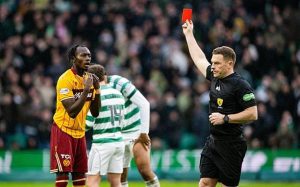
The challenge resulted in a penalty for Celtic F.C. and a straight red card for Emmanuel Longelo.
Former Premier League referee Dermot Gallagher later explained why the decision was absolutely correct, even comparing it to a recent incident in England involving Virgil van Dijk.
Speaking on Ref Watch on Sky Sports News, Gallagher said the intervention from VAR ensured the right outcome was reached.
“I think VAR has done really well for the referee because it’s a foul,” Gallagher said. “It has to be a red card because the defender makes no attempt to play the ball. The ball isn’t even close to him — he simply drags the player down.”
The incident followed a Celtic corner, with Maeda attacking the near post when Longelo grabbed him from behind and pulled him to the ground.
Referee John Beaton initially allowed play to continue, but after a VAR review the decision was overturned. Celtic were awarded a penalty and Longelo was sent off — a moment that proved crucial as the home side went on to claim an important victory in the title race.

Gallagher also compared the situation to a recent Premier League match between Liverpool F.C. and Tottenham Hotspur F.C.. In that game, van Dijk appeared to pull back Richarlison as the Brazilian tried to break through on goal.
“In that moment Richarlison was running through on goal and van Dijk was pulling him back by the shoulder to stop him,” Gallagher explained. “Richarlison still managed to get a shot away, but he clearly felt he was being held and believed it should have been a foul — which could have resulted in a red card.”
Despite the comparison, Gallagher stressed that the Celtic incident was far more obvious.
Former Premier League striker Jay Bothroyd added that the Motherwell goalkeeper’s position played a big role in the decision.
“The key factor is where the goalkeeper is,” Bothroyd said. “He’s out of position, which means the goal is effectively open.
If the keeper had been in place, you could argue it wasn’t an obvious goalscoring opportunity. But because he wasn’t there, it clearly was — so the red card was the right call.”
Their analysis explains why Celtic supporters felt the decision was fully justified. With a clear foul, an open goal situation and VAR confirming the incident, it was a textbook example of a penalty and a red card.
For Celtic, the moment helped secure three vital points and reinforced their push in the Scottish Premiership title race. At the same time, the debate over refereeing consistency and VAR decisions — including comparisons with high-profile Premier League incidents — continues to fuel discussion among fans and pundits.
As the season progresses, the Maeda–Longelo incident could be remembered as a defining moment — not only in the match itself but also in the ongoing conversation about VAR and officiating standards in modern football.


 admin
admin