 admin
adminThere are stages late in a season where everything feels finely balanced — not just the results, but the decisions that shape them. The smallest calls can stretch far beyond one match, influencing the course of an entire title race.
This was one of those moments.
With Celtic, Rangers and Hearts locked in a relentless battle, every weekend now carries heightened intensity. It is no longer just about winning — it is about timing, execution, and, at times, the judgment of officials in defining moments.
At Tynecastle, the match had already produced its share of drama.
Hearts and Motherwell were level as the clock ticked down — the kind of contest where a single goal can alter everything, not only for those on the pitch but for the wider title race taking shape.
Then came the flashpoint.
In an instant, a challenge inside the box unfolded. At first glance, it seemed routine — a defensive clearance, play continuing without interruption. No whistle, no immediate protest.
Yet something felt off.
Moments later, the game was halted.
A turning point decision
Referee Matthew MacDermid initially allowed play to continue as Motherwell cleared their lines. However, in the VAR room, a different conclusion was forming.
Steven McLean stepped in.
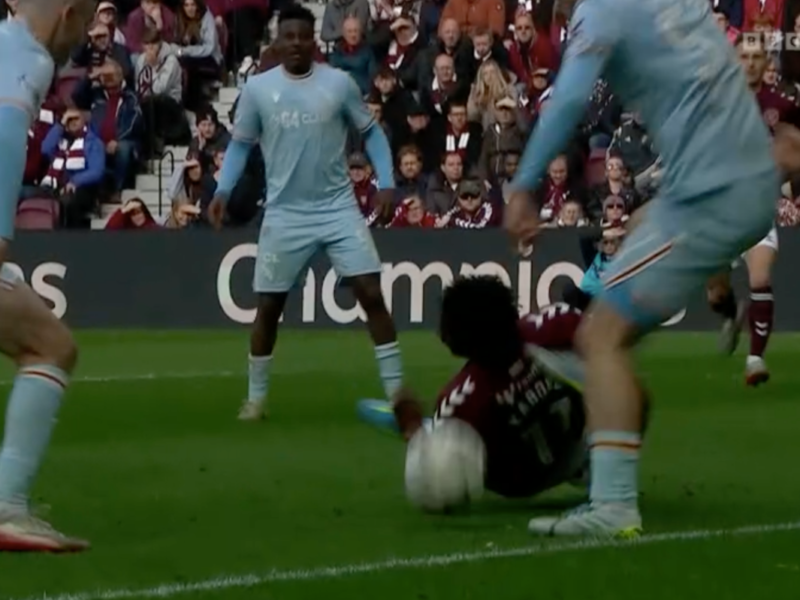
Replays showed Celtic loanee Stephen Welsh making contact with Landry Kabore’s head as the Hearts player, grounded in the box, attempted to meet the ball. It was subtle in real time — far from an obvious foul.
But VAR deemed it significant enough.
A penalty was awarded.
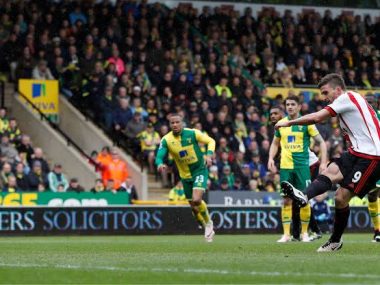
In the 88th minute, with tension at its peak, Lawrence Shankland stepped up and converted. The momentum shifted instantly. Hearts moved from chasing the game to commanding it, and soon after added a second to secure a 3-1 victory — a result that keeps them firmly in control of the title race.
For Motherwell, it felt like the game had slipped beyond their control.
For Celtic and Rangers, watching from afar, it marked yet another twist in an already unpredictable campaign.
But the real controversy was only beginning.
“Unfair” or justified?
The decision quickly divided opinion.
Motherwell manager Jens Berthel Askou did not hide his frustration, clearly feeling his side had been on the wrong end of a crucial call.
He was not alone.
The Ref’s View podcast — hosted by former Scottish Grade One referees Des Roache and Steve Conroy — strongly opposed the decision. Citing IFAB laws, they argued it did not meet the threshold for a penalty.
They pointed to the definition of dangerous play:
“Any action that, while trying to play the ball, threatens injury to someone (including the player themself).”
Their verdict was blunt — no penalty should have been given. From their perspective, Kabore had put himself in danger by attempting to head the ball from the ground, while Welsh was simply making a legitimate clearance.
In that light, the call was not just debatable — it was unjust.
But football rarely offers a single, uncontested interpretation.
A contrasting perspective
Others saw it differently.
Former Hearts player and manager Steven Naismith offered a more supportive view of the decision after the match.
Initially unconvinced, his stance shifted after reviewing the replay.
“At first, I didn’t think it was a penalty,” he admitted.
“But when you see it again, it’s like any situation where an attacker reaches the ball first — if the defender then makes contact, it becomes a foul.”
He acknowledged the unusual nature of the incident, given Kabore’s position on the ground, but maintained that getting to the ball first was decisive.
For him, it was the correct call.
A moment bigger than the match
What elevates this incident is not just the debate itself, but its timing and consequences.
The penalty did more than decide a game — it shifted momentum in a title race where margins are razor-thin. Hearts emerged with three points and renewed control, while Motherwell were left with lingering frustration.
Elsewhere, Celtic and Rangers will be watching closely, fully aware that moments like this could ultimately shape where the title ends up.
Because at this stage of the season, success is no longer defined purely by performance.
It comes down to margins.
And sometimes, those margins hinge on a single decision that continues to divide opinion long after the final whistle. ⚽

 admin
admin